The Art of Pixelated Perseverance: A Game Over Screen
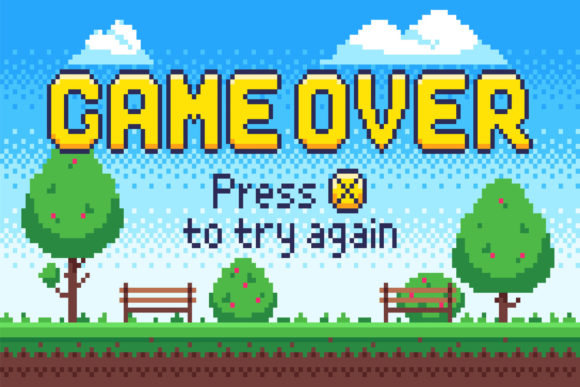
Imagine the flicker of a CRT monitor, the muted beep of a synthesizer, and that stark, iconic message flashing before you: "GAME OVER." It's a moment of profound resonance in digital culture, a universal signal of a challenge unmet. This specific Game over Screen illustration captures that essence perfectly. It's not just a generic icon; it's a meticulously crafted vector artwork that embodies the aesthetic of retro 8-bit arcade games, complete with a pixelated failure scene and the classic "press X to try again" prompt. For professionals, creators, and enthusiasts across fields, this asset is more than nostalgia—it’s a practical tool for communication and design.
Why a Pixel-Perfect Game Over Screen Matters
In a world saturated with sleek, modern graphics, the deliberate retro style of an old pixel video game end holds unique power. It communicates concepts of trial, error, resilience, and iteration instantly and visually. This isn't merely decoration. This Game over Screen vector illustration serves as a shorthand for a narrative. Whether you're a marketer crafting a campaign about learning from setbacks, an educator designing materials on growth mindset, or a game developer creating authentic indie titles, this asset provides a ready-made, high-quality visual metaphor.
The value begins with its format. Provided as a vector EPS10 file, it offers infinite scalability. You can enlarge it for a poster or shrink it for a website icon without any loss of quality. The companion JPEG preview gives you a quick reference. This technical foundation means the asset is adaptable, saving you significant time compared to creating a similar illustration from scratch. It’s a professional-grade starting point.
Practical Applications Beyond Gaming
Consider a project manager creating a presentation about a product launch that encountered early hurdles. A slide titled "Phase 1: Our 'Game Over' Moment" featuring this pixelated scene would immediately engage the audience, framing the discussion around constructive failure and the subsequent "try again" effort. The visual breaks the monotony of typical corporate graphics and strengthens communication through shared cultural understanding.
For bloggers and content creators, this Game over Screen can be a versatile graphic. It could illustrate articles on topics like entrepreneurial resilience, the scientific process of experimentation, or even personal development. Its aesthetic stands out in social media feeds, attracting attention and conveying your theme before a reader even scans the text. It supports creativity by giving you a distinctive element to integrate into your unique visual style.
Unlocking the Asset for Your Specific Needs
The description notes a key feature: "If you want to separate elements, remove or edit something, please use a vector editor e.g. Adobe Illustrator." This is where the real utility shines. You are not locked into a static image. The death and try again arcade gaming illustration is composed of individual vector elements. Perhaps you only need the "press X to try again" sign for a tutorial on user interaction. Maybe you want to isolate the pixelated "GAME OVER" text to use as a font-inspired logo for a podcast about retro tech. With a vector editor, you can deconstruct, recolor, or modify components to solve your specific design problem.
This flexibility is invaluable for freelancers and small business owners who need to produce varied client work without constantly purchasing new assets. One file can be repurposed across multiple projects, increasing efficiency and improving presentation quality with a coherent visual thread.
Who Benefits Most from This Retro Visual?
The audience is broad because the concept is universal. Educators and trainers can use it to make lessons about perseverance more relatable. Marketing professionals targeting a demographic familiar with retro gaming culture can leverage it for authentic engagement. Indie game developers and hobbyists working on pixel art projects get a high-quality, ready-to-use screen for prototyping or final art. Even publishers designing book covers for topics on failure and innovation might find it a compelling element.
The benefit is about meaningful association. Using this Game over Screen connects your content to deeply ingrained ideas of challenge and second chances. It does so with a style that feels intentional and crafted, avoiding the cliché of a low-resolution screenshot. It adds character and specificity.
Considerations and Optimal Use
While the asset is versatile, its use requires thoughtful consideration. The pixel art style is inherently stylized. It may not fit a project requiring ultra-modern, minimalist, or formal aesthetics. For a corporate annual report on financial losses, a more abstract graphic might be preferable. This illustration thrives in contexts where a touch of personality, nostalgia, or clear metaphor is welcome.
Also, while the vector format allows extensive editing, it does require access to and basic knowledge of vector editing software like Adobe Illustrator. The JPEG preview is useful for placement ideas, but to truly unlock the asset's potential—separating elements, changing colors—you need to work with the EPS file. For users without that software or skill, the asset remains useful as a fixed, high-quality image, but its core flexibility would be a limitation.
When comparing options, this particular Game over Screen stands out because of its complete scene composition. It's not just text; it includes the "try again" prompt and the evocative pixelated background, offering a full narrative moment. Other assets might offer only the text or a different stylistic take. Your choice should depend on whether you need that complete story fragment or just a component of it.
Integrating the Game Over Screen into Your Workflow
A practical recommendation is to import the EPS file into your vector editor and immediately explore its layers. Identify the separate elements. You might discover that the background pixels, the text shadow, and the notification prompt are distinct. This exploration helps you plan how to use it. For a quick task, like a blog header, you could use the entire scene as-is. For a more integrated design, like a website section illustrating a "trial and error" process, you could extract the "press X" button and animate it separately, using the vector paths as a foundation.
The asset simplifies decisions by providing a high-quality answer to the question: "How do I visually represent failure and recovery?" It solves the problem of sourcing or creating such an icon. Your time is then spent on adaptation and implementation, not on initial creation.
Ultimately, this vector illustration of a Game over Screen is a bridge between a shared cultural experience and professional communication needs. It translates the poignant end of an 8-bit arcade game into a tool for modern storytelling, design, and education. By harnessing its scalable format and editable nature, you can support your goal of creating content that resonates deeply, works efficiently, and stands out visually. It reminds your audience—and perhaps yourself—that every "game over" is just a precursor to pressing "X" and trying again.